
Into the Blue by Emma Brodie is the most brilliant, beautiful, frustrating book I’ve read in a long time. And I think that last part is intentional.
AJ and Noah meet when they are 17 and 21 respectively, working at Reel World video store in the year 2000. While AJ is initially reluctant to be working with Noah—the youngest member of a Barrymore-esque acting family, they bond over a mutual appreciation of a sixties sci-fi improv show, reminiscent of Star Trek, that also happened to star his aunt.
Their bond is further cemented when Noah’s aunt begins working with them both in the art of acting, and more importantly, improvisation. It is here where the book starts to play with themes of shared consciousness and fate. Despite the incredible bond they share, Noah leaves AJ heartbroken near the end of that summer.
Their paths converge over the next several years. In this, their relationship becomes a tug-of-war of love and desire, rejection and sacrifice.
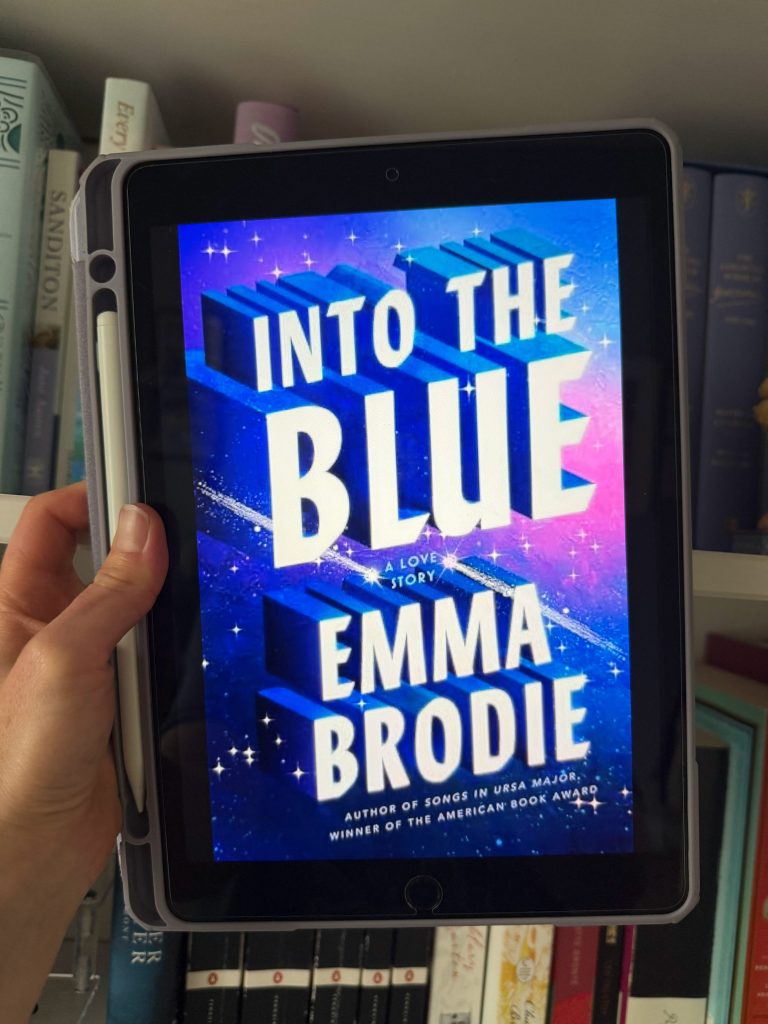
Many of the reviews I’ve read express frustration with Noah, who makes decisions he feels are best for AJ without consulting or listening to her. I can empathize with Noah about why he felt those decisions were necessary, at least initially, especially considering comments a very young AJ made to him without knowing all the details. Her words would have stayed with him and influenced him. What infuriates me the most about Noah is how he continues to keep AJ on a sort of tether to him, even after insisting they must part.
But that really is the headiest part of the book: these two characters are tethered. A clean break is impossible.
AJ herself is not morally superior to Noah. She is flawed and has her own struggles. While the book is largely told from her third person perspective, which I believe means we are meant to empathize with her the most, AJ also makes questionable decisions of her own.
For Noah and AJ, there is no clearcut answer, as much as we might want there to be one. As a Christian, my kneejerk reaction to one of Noah’s decisions about his future was one of dismay. But I do believe, especially as the book draws to a close, that Emma Brodie is asking us to hold off judgement and consider why Noah may believe that is necessary.
One major critique of the novel I have read is the sheer quantity of sex scenes. I chose to skip them, so I cannot comment on their content, only that there is a lot. Personally, I felt AJ and Noah had a strong enough connection between them without veering in this direction, but my preference is for closed-door content. It is likely that Emma Brodie is echoing AJ’s own response to a question fielded to her in a misogynistic interview—that art can be both cerebral and base.
Into the Blue is certainly a cerebral novel. I feel it is one that will be added to lit class syllabi in the future. I enjoyed the narrative texture deviating from the typical chapter structure. As a third generation Trekkie, sci-fi fan, and occasional con attender, I loved these elements as well. I also enjoyed the magical realism of certain aspects of the book.
Additional content warnings include very frequent strong language and sexual references. Trigger warnings include neurodegenerative disease, death of a parent, alcoholism, abandonment, critical injury, and suicidal ideation.
Am I glad I read Into the Blue? Absolutely. In time, it’s one I will likely reread. It’s a book best taken in its time, not rushed. Should you read it? I don’t think I can give a blanket recommendation for it. It is certainly worth considering if you are looking for a thoughtful read guaranteed to haunt you long after it’s over.



 Home
Home 
Leave a comment